


Losing a tooth, whether due to advanced decay, an accident, or a lack of dental care, is never desirable. But when it happens, the first question that arises is: what can replace the missing tooth? Two solutions are most common: a dental bridge and a dental implant. Both restore the appearance and function of a missing tooth, but they work very differently. Your dentist at Centre Dentaire Georges in LaSalle explains the differences between them.
What is a Dental Bridge?
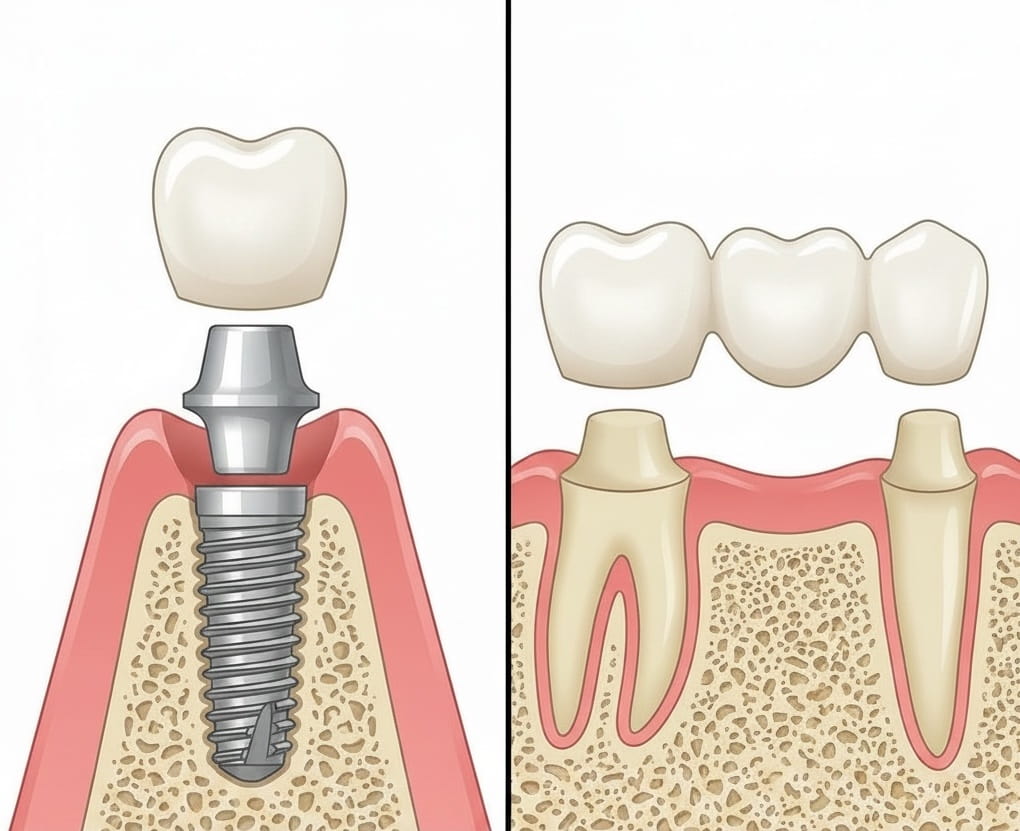
A dental bridge is a fixed prosthesis that fills the gap left by one or more missing teeth. It usually consists of two crowns, placed on the natural teeth on either side of the gap, which support a false tooth in the center, or two teeth in some cases. To receive these crowns, which are the bridge’s anchors, the adjacent teeth must be filed down, permanently altering them.
What is a dental implant?
A dental implant works differently. It is a small titanium post surgically inserted into the jawbone, acting as an artificial root. Over time, the bone naturally fuses with the titanium, a process called osseointegration. Once this integration is complete, a crown is attached to replicate the missing tooth. Unlike a bridge, an implant does not require any work on the neighboring teeth.
The key differences:
Impact on neighboring teeth
A bridge requires irreversibly grinding down the adjacent teeth. Since part of the enamel, and therefore the natural structure, is removed, these teeth are weakened. An implant, on the other hand, leaves the neighboring teeth intact.
Level of intervention and time frame
A bridge is generally completed in a few weeks, in two or three appointments, without surgery. An implant requires surgery and several months of waiting while osseointegration is complete.
Effect on the jawbone
An implant stimulates the bone, like a natural tooth root, which helps prevent bone resorption over time. A bridge does not have this effect, since it only replaces the visible crown.
Prerequisites
An implant requires sufficient bone volume in the jaw. If there is not enough, a bone graft may be necessary before implant placement, which lengthens the process.
Durability
Both solutions are durable when properly maintained, but their profiles differ depending on each patient’s situation.
How do you know which option is right for you?
There is no one-size-fits-all answer. The right choice depends on several factors: the condition of your adjacent teeth, the amount of available bone, the number of teeth to be replaced, and your personal priorities in terms of time and budget. A bridge can be an excellent option if the neighboring teeth already require crowns. An implant is often recommended when the goal is to preserve healthy teeth.
Do you have a missing tooth and are wondering which solution would be right for you? The team at Centre Dentaire Georges in LaSalle is here to answer your questions and guide you in your decision.